The project has been commissioned by the KNSB (Koninklijke Nederlandse Schaatsenrijders Bond) with the purpose to improve the safety of short track safety padding within a boarded ice hockey rink.
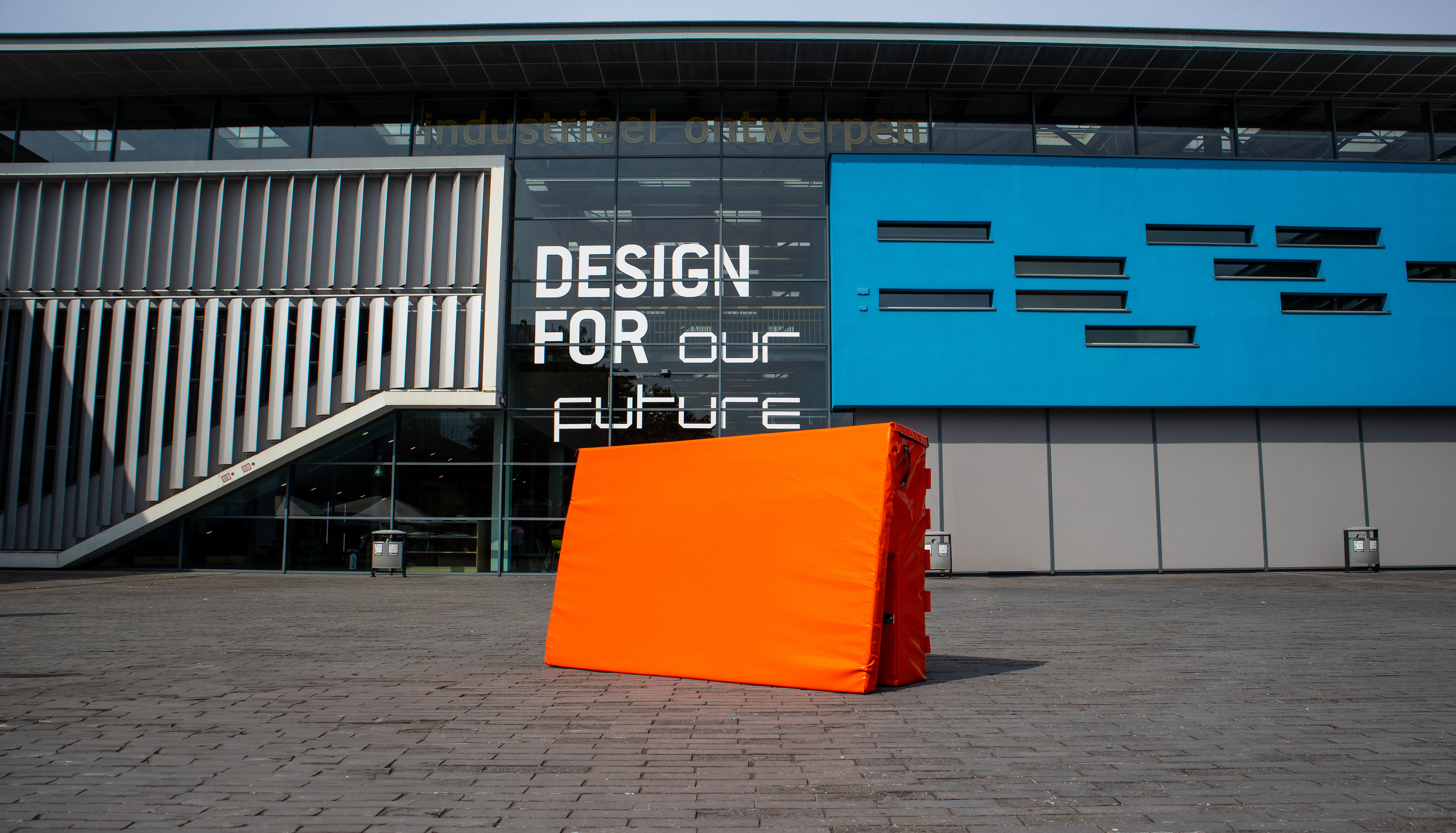
Currently, the existing padding for short track skating on ice hockey rinks is not safe enough and still major crashes with severe injuries occur. In The Netherlands there are only sixteen ice hockey rinks. However, in countries like Canada, USA, Switzerland, China and in Scandinavia, there are hundreds. This offers a huge potential for the sport to grow. However, the safety of the sport first needs to improve before these countries are willing to offer the sport to a broader group of sporters.
Based on extensive research and testing, Arc is designed. Arc is a padding based on the principle of using two dampening methods to reduce the impact of the skater.
The Arc consists of different types of foam which are placed in a sandwich structure. The front leg of the padding is hit first by the skater and needs to bend slowly to absorb a lot of energy. For this reason, it is made out of hard and dense foam. In the design, a stiffer type of foam is selected for this part. To make the Arc more stable in case of a crash, an angle is added to the front of the Arc to bring the centre of gravity backwards and reduce the risk of toppling.
Furthermore, a softer foam is implemented for the parts made of soft foam. The soft layer of foam at the front is made thicker so more energy can be absorbed at first and to ensure a softer landing for the skater. In addition to using a softer foam in the back leg, the structure of air chambers is changed to a chequered structure with only vertical cutouts, as testing showed that this absorbed high impacts better.
Lastly, the firm foam behind the triangle was shortened in length. In the final design, this foam is placed only behind the triangle, so when the front leg hits the back leg there is no collision of firm foam plates anymore. This helps decrease the deceleration peak when the skater hits the back leg.
The casing protects the foam sandwich and can be opened to place and remove the foam (figure 13). A few improvements were implemented after the testing. In the final casing design, the hook and loop fastener for opening the casing is placed on the back and top side, enabling the casing to flip over the front face. Originally it was placed on the front and top side by mistake due to miscommunication with the production facility. This was inconvenient as the front face is usually made of a different material, and several pieces of fastener would interfere.
The casing is made from different kinds of pvc coated fabrics. The two main functions of the casing are to protect the foam structure from cuts and the environment and to enable the short track skater to glide along the surface of the padding.
To make it possible to repair the casing or the foam inside, the user or the manufacturer should be able to take the foam and casing apart.
Furthermore, the improved casing is made out of separate sheets of fabric instead of one circular tube of casing as this allows for using different materials. The lower parts of the casing which touches the ice, are made of a thicker, more waterproof material that slides easily over the ice. Additionally, the front face is made of a cut resistant material. The sides, top and back material remains the same as in the prototype, just as the mesh that is on the top of the padding.
Lastly, AirKnit is used for the advertisement banners. This material allows the helmet of short track skaters to slide easier, preventing them from injuring their neck. A training version of this will also be made for when there are no advertisements displayed. This will be attached the same way as all current paddings, by hook and loop fasteners.
These handles are oriented to be optimal for carrying the padding piece horizontally, but not for rotating the padding piece. As the padding pieces are stored horizontally on carts but are placed on the ice vertically, rotating the padding piece should be taken into account for the optimisation of the handles
Over the months several different tests were conducted to see if the principle was working or not and how it could be improved. From starting with a simple test setup to see how different shapes of foam react, to the real ISU drop test and 1:1 tests.